May 5, 2026 • 8 min read
Hostel Travel in India: What First-Time Travellers Actually Need to Know
Gamana Editorial Team
Travel Innovation
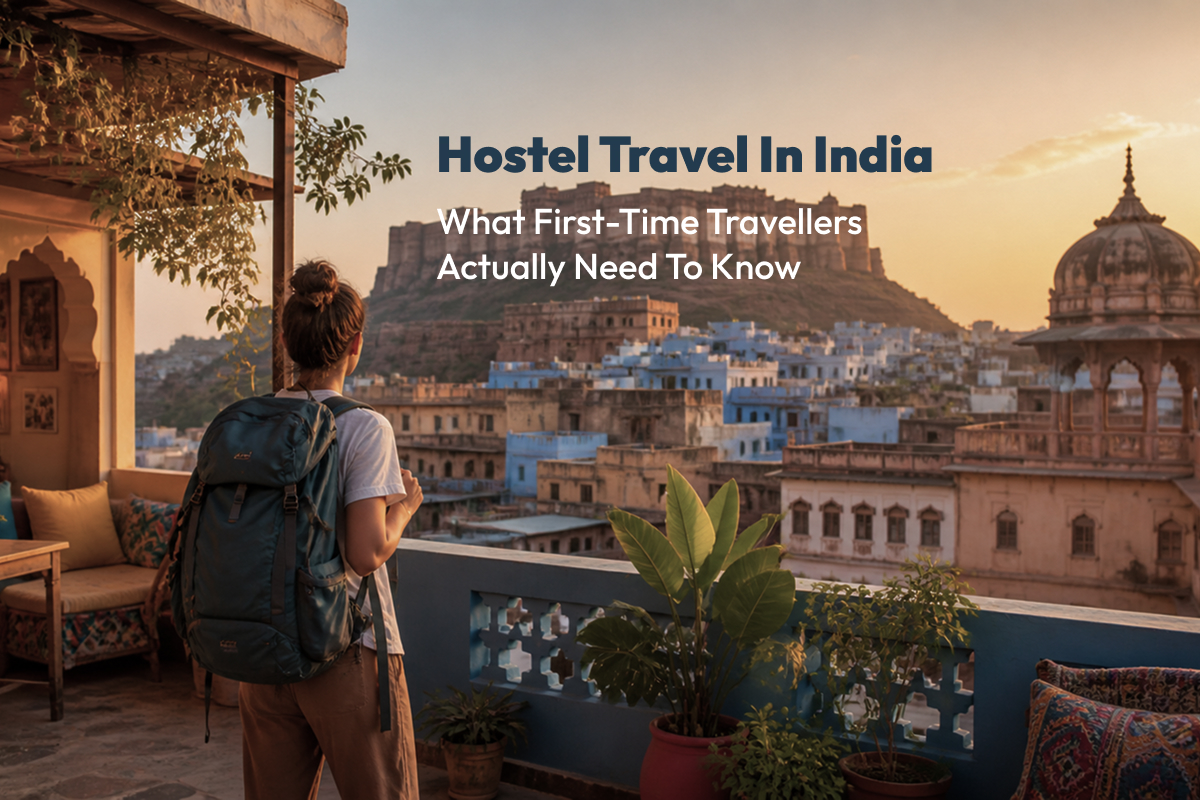
India does not ease you in gently. It arrives all at once — the sounds, the colour, the chaos, the warmth, the history layered on every street corner. For first-time visitors from the US, UK, Europe, Canada, or Australia, it is one of the most rewarding and disorienting places you can choose to travel independently.
The decisions you make early — where you stay, how you move, and how you make sense of what you are seeing — shape your entire experience. And for a growing number of independent travelers, hostel travel has become the starting point that makes everything else click.
Here is what you actually need to know before you land.
Why Hostel Travel Fits India So Well
India is a country that rewards flexibility above almost everything else. Trains run late. Cities surprise you. Plans dissolve, and better ones take their place. Hostel travel is built for exactly this kind of trip.
A good hostel in India is not just affordable accommodation. It functions as a soft landing in a place that can otherwise feel overwhelming on arrival. It gives you:
- Practical, street-level advice from hosts who know the city better than any travel app
- A ready community of travellers in the same position as you, asking the same questions
- The flexibility to change plans without financial penalties
- A safe, social base while you find your rhythm
India now has over 1,200 hostels listed across 188 cities on Hostelworld alone. The backpacker infrastructure is mature, well distributed, and genuinely useful.
Where First-Time Travelers Usually Begin
Most first-time Western visitors follow some version of a classic route. These itineraries exist because they work, and they are also the cities where India's hostel culture is strongest.
The Golden Triangle and North India
Delhi, Agra, and Jaipur remain the most common entry points. Delhi for its layered urban history, Agra for the Taj Mahal, Jaipur for its forts, palaces, and Rajput grandeur. Many travelers then continue to Rishikesh for yoga culture and the Ganges, or Varanasi for one of the most spiritually intense cities on earth.
Rajasthan and the West
Udaipur, Jodhpur, and Pushkar attract travelers looking for heritage, colour, and a slower pace. Goa sits at the end of many Rajasthan routes, offering beaches, Portuguese architecture, and a completely different tempo.
South India
Kerala, Hampi, Mysore, and Hyderabad are seeing growing numbers of independent travelers. South India rewards those who venture beyond the north-heavy classic route.

What to Look For in an India Hostel
First-time travelers tend to prioritize the same four things. They are worth taking seriously.
Cleanliness
India is intense enough on its own. Accommodation should not add to the friction. Read recent reviews specifically for cleanliness, not just overall ratings.
Reliable Wi-Fi
This is not a luxury. You need it to book onward trains, call rides, confirm reservations, and navigate. A hostel with poor connectivity is a genuine inconvenience.
Knowledgeable Hosts
The best hostel staff in India are worth more than any guidebook. Good local advice on timing, transport, and neighborhoods regularly saves travelers hours and real money.
Social Without Being a Party Scene
Many independent travelers want to meet people without being forced into late nights. Look for hostels described as community-focused rather than party hostels, unless that is precisely what you want.
Hostel Brands Worth Knowing
A handful of names consistently surface in honest traveler conversations:
Zostel is the most recognized backpacker brand in India and covers the widest range of destinations. A solid default for first-timers.
The Hosteller offers a consistent multi-city network that is useful if you are moving across several destinations.
goSTOPS leans toward comfort and reliable amenities. Good for travelers who want the social element without sacrificing basic standards.
Madpackers is well regarded for its warmth and community atmosphere. Often feels more personal than the bigger chains.
Moustache has a more design-conscious approach and tends to attract travelers who want something slightly elevated without leaving the hostel category.
None of these is perfect for every traveler. Read recent reviews for the specific city you are visiting, not just the brand overall.
The Real Challenges of Hostel Travel in India
Hostel travel in India is excellent but not without friction. These are the honest challenges and how experienced travelers handle them.
Train Bookings Are Confusing at First
India's rail network is extraordinary but the booking system, IRCTC, takes some learning. Ask your hostel staff to help you understand tourist quotas, Tatkal tickets, and class differences. They do this every week.
Getting from Stations Can Be Chaotic
Pre-book your first arrival transport wherever possible, or ask your hostel to arrange a trusted driver. Avoid unmarked cabs late at night, especially in large cities.
Not Everything Is Self-Explanatory
This is the one travelers underestimate most. India is extraordinarily rich in history, religion, and cultural meaning. A hostel will tell you where to go. What it cannot always do is help you understand what you are actually looking at.
Food Decisions Can Feel Overwhelming
Ask your hostel for specific recommendations rather than wandering without direction. Their suggestions are usually reliable, often nearby, and almost always better than random choices.
What Hostels Cannot Give You
Here is something most hostel travel guides skip over entirely.
Practical help and cultural understanding are two different things. A hostel will point you toward the ghats in Varanasi. It will rarely explain how the city's sacred geography works, why certain ghats carry more significance, or what the rituals you are watching actually mean to the people performing them.
In Jaipur you might get directions to the forts. What you are less likely to receive is a framework for understanding Rajput history, how the city was designed, or what the architecture says about the people who built it.
In Delhi you can move between neighborhoods with a solid map. What takes more effort to find is a coherent sense of how Old Delhi, Mughal Delhi, colonial Delhi, and modern Delhi all fit together into a single city.
This is not a criticism of hostels. It is simply worth knowing before you go, so you can plan for it.

How Smart Independent Travelers Are Filling That Gap
This is where the way people travel India has shifted quietly but noticeably in recent years.
More first-time independent travelers are building what you might think of as a layered approach to their trip. A hostel provides the social base, the community, and the practical ground-level help. A self-guided audio tour fills in the cultural layer — the history, the context, and the stories behind what they are seeing.
Audio guide apps like Gamana fit this kind of travel well for a few specific reasons:
- They work at your own pace, with no fixed group departure and no rushing
- They are significantly cheaper than hiring a guide at every site
- They give you a ready structure for each city, useful when you do not yet know how to prioritize your time
- They offer curated historical and cultural context in a format designed for walking exploration
- Offline download means you are not dependent on strong connectivity while you are out
The hostel helps you land and orient yourself. The audio guide helps you actually understand where you are.
For a country as layered as India, that combination matters. A monument can be visually stunning without being self-explanatory. A neighborhood can look chaotic while holding centuries of compressed history. A ritual can be deeply moving without being immediately intelligible.
Travelers who come away from India feeling like they understood it, rather than just experienced it, have usually found a way to bridge both.
Practical Tips Before You Land
A few things that make a real difference on the ground:
- Book your first two nights in advance. Give yourself a landing pad before you start adapting.
- Arrive in daylight where possible. Indian cities are easier and less stressful to navigate when you can see what is around you.
- Pack a padlock. Most hostel dorms have lockers. Not all provide locks.
- Download offline maps. Google Maps offline mode is genuinely useful in areas with variable connectivity.
- Carry small denomination notes. Tuk-tuks, chai stalls, and market vendors rarely have change for large notes.
- Ask your hostel first. Before booking anything or heading anywhere unfamiliar, ask the staff. Their local knowledge is almost always more reliable than what you find online.
The Bottom Line
Hostel travel in India is not simply about saving money. It is about building the kind of trip that actually fits the country: flexible, social, open to the unexpected, and grounded in a real base of practical support.
The travelers who get the most from India tend to combine that social foundation with a genuine effort to understand what they are seeing — not just photograph it and move on. The hostel gives you the first. How you approach the second is up to you.
India is one of the most historically rich, culturally layered, and sensory intense destinations in the world. Arriving with the right base and the right tools to understand it does not make the experience smaller. It makes it more readable. And more often than not, that is what turns a good trip into one you will spend years trying to explain to people who were not there.